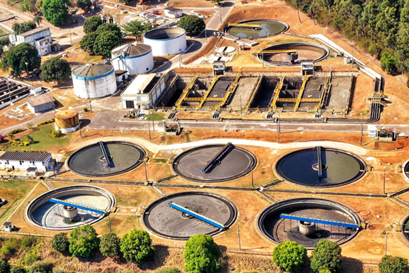
Since 2010, Marselisborg wastewater treatment plant has transformed its focus beyond minimizing energy consumed, to maximizing net energy surplus. Nowadays the facility has net production of both electricity and heat, supplying the district heating system in Denmark’s second-largest municipality, Aarhus. The carbon footprint has been reduced by 35 % accordingly.
Water and wastewater treatment facilities are normally the single largest electricity consumer for a municipality. Typically water and wastewater treatment processes account for 25 – 40 % of the municipal electricity consumption. The high consumption is related to the energy intensive processes but also its continuous operation cycle, 24/7 and 365 days annually.
Over the years focus has been on developing new processes and control strategies to reduce energy consumed per liter of water processed. However, at the same time the increasing demands upon wastewater treatment quality, for example in nutrient removal, in turn increase net energy consumption.
Water and wastewater treatment processes are characterized by high load variation during the 24-hour cycle and seasonally throughout the year. The use of frequency converters has therefore steady increased in order to control blowers, pumps and other motorized equipment, to adapt to the changing demand.
Since 2010 Aarhus Water has worked intensively together with water environment consultants to improve the energy balance for Marselisborg wastewater treatment plant.
Our VLT® AQUA Drive is updated with the latest patented edge computing technology. Supporting high uptime for your facility and saving on operating costs, by supervising your motor and pumps. With the edge computing solution, data is collected several times per second, ensuring that any measurements outside the normal range trigger a warning, thus minimizing the risk of undetected abnormalities.
Learn more
These changes together with improvements including the effective co-production of electricity and heat based on methane gas extracted from the aerobic sludge digestion process have created the impressive results of:
Frequency converters are installed on almost all rotating equipment at Marselisborg WWTP: blowers, pumps, mixers and dewatering pumps. The frequency converters allow the plant to adapt to load variations, with maximum flexibility. Over 100 motors are controlled by VLT® frequency converters at Marselisborg.
The vision for Aarhus City is to extend energy generation even further, to achieve surplus production of energy from its wastewater treatment plants so high, that it can also meet the energy requirement of the city’s potable water supply. This will transform the single largest electricity consumer for the authority into an energy-neutral party.
Read the story as a PDFRead more about water and wastewater
Brazilian water utility CAESB relies on DrivePro® services for planned maintenance and guaranteed response time to improve predictability in water management. Refurbished drives and upgraded units have extended the lifetime of their equipment, reduced the risk of downtime, and brought control to both operations and budgets.
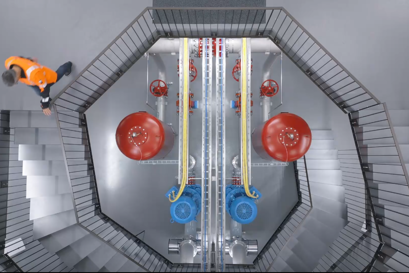
SWITZERLAND: The Wehrliau pumping station in Bern delivers up to 1.20 M liters of drinking water hourly. iC7 drives play a key role in ensuring reliable supply.
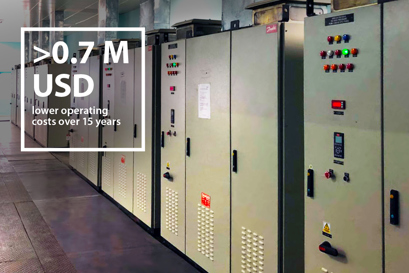
INDIA: By using VLT® AQUA Drive FC 202 from Danfoss, Koyambedu wastewater treatment plant has reduced its energy consumption significantly.
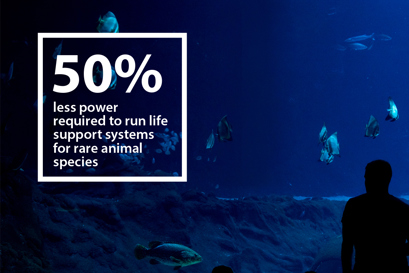
POLAND: The Lodz Zoo Orientarium uses high-efficiency VLT® AQUA Drive FC 202 to secure reliable water quality in life support systems for rare animal species.
Marselisborg Wastewater Treatment Plant went from energy consumer to energy producer by using VLT® AQUA Drive FC 202 from Danfoss. Learn more about that here.
AC drives from Danfoss help convert biomass from insulin and enzyme production to energy.