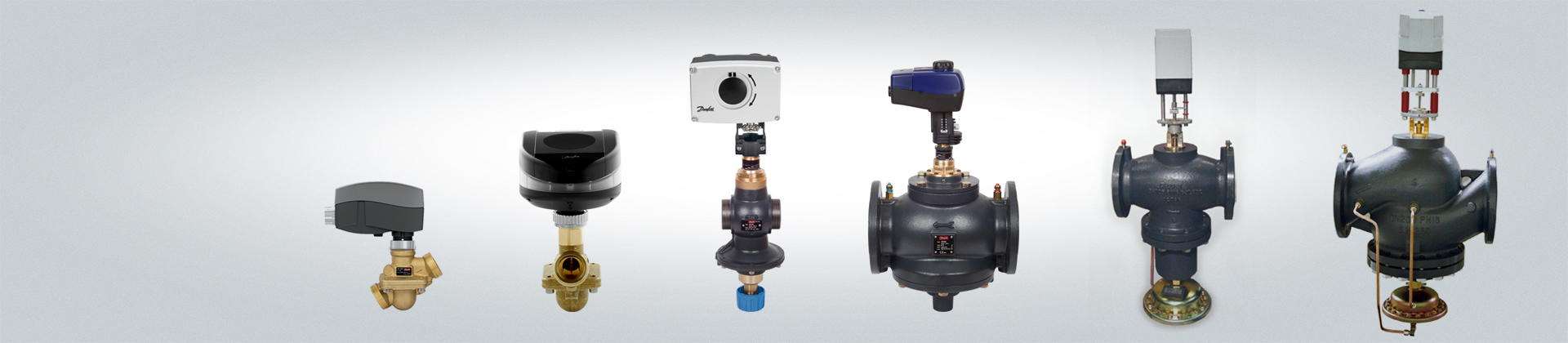

Danfoss has been engineering innovations designed to enhance comfort & save energy for over 80 years. Learn more about our sustainable building technology like AB-QM™ in our Sustainable Buildings video below...
Play video
Discover how Danfoss AB-QM™ Pressure independent control valves (PICVs) can improve system efficiency by eliminating overflows and increasing ΔT.
AB-QM™ is a pressure independent control valve with a built-in, integrated differential pressure regulator. The unique design allows the valve to be selected via required flow versus traditional Cv calculations.
When equipped with a perfectly matched Danfoss electric actuator, AB-QM™ PICVs increase energy efficiency & room temperature control, improving indoor climate conditions. PICVs are typically found in HVAC heating and cooling systems.
Mechanical pressure independent technology
Integrated differential pressure regulator for exceptional flow control.
Easy setting and sizing
Selecting the right AB-QM™ is much less complicated than sizing and selecting conventional control valves, and no Cv calculations are required.
Wide range of valve sizes
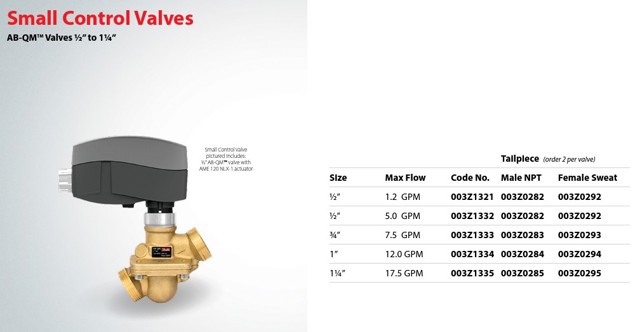
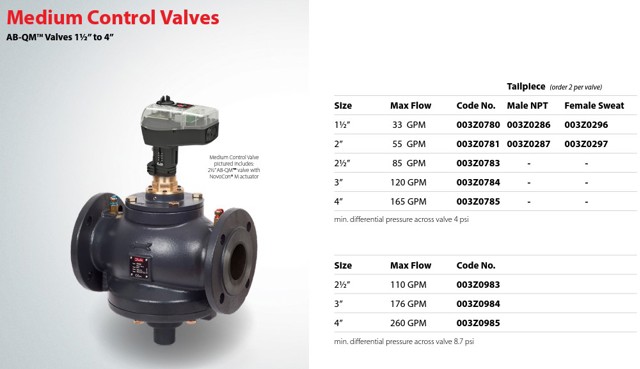
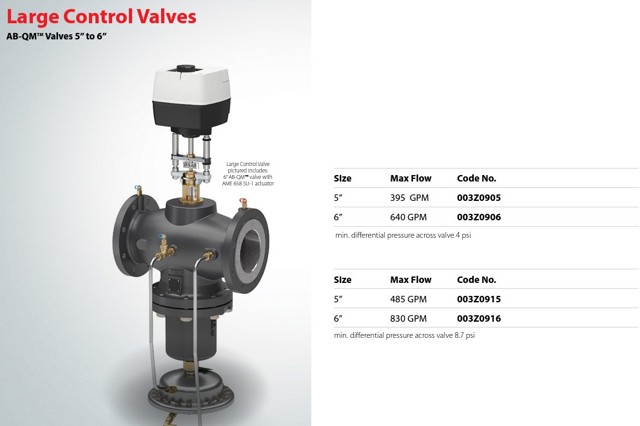
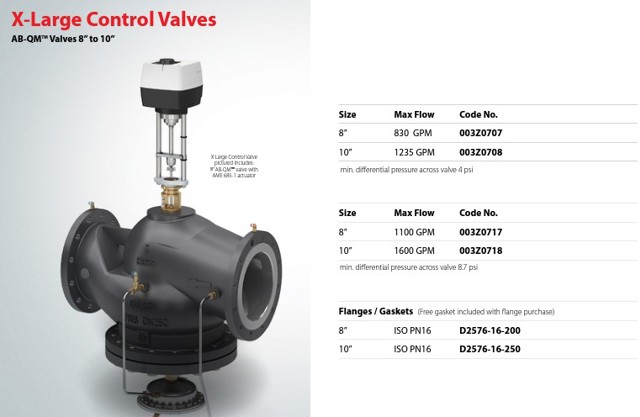
Valves are available in ½” through 10”, covering a wide variety of HVAC applications.
Field adjustable flow setting
No tools are required for the ½" to 1-¼" valves. Simply lift, rotate, and lock valve adjustment knob on your required flow setting.
Tight close-off/clog resistant
Unique two-stage close off resists debris.
Watch a brief overview of Danfoss AB-QM™ pressure independent control valves, see how they work, and how they can help optimize your HVAC system.
The integrated control valve with flow limitation and automatically provides more or less flow through the valve depending on the selected actuator.
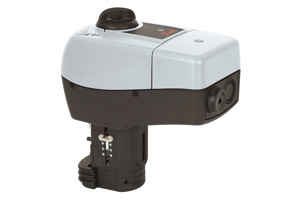
A variety of complimentary actuators are available that work synergistically with the AB-QM™ valve, maximizing the balancing & control features of the valve. Select your actuator based on your desired control input features for your application.
Find links to all relevant technical literature including datasheets, case studies, instructions, and more.
View literature
A. Control Valves:
Factory fabricated pressure independent with internal differential pressure regulator (DPRV) which automatically adjusts to normal changes in system pressure and provides 100 percent control valve authority at all positions of the valve; maintain proportional/linear flow coil characteristics; and maintain a liner flow characteristic. The PICV shall accurately control the flow from 0-100 percent full rated flow with an operating pressure differential range of 3 to 60 PSIG, FCI 70-2 Class 4 shut-off on all sizes and field serviceable. Control valve shall incorporate control, balancing and flow limiting. Hydronic system pressure independent control valve bodies shall meet ASME B16.34 or ASME B16.15 pressure and temperature class ratings based on the design operating temperature and 150 percent of the system design operating pressure and shall have the following characteristics:
1. NPS 2 and Smaller: Class 150 bronze or brass body with union connections, stainless steel trim, stainless steel rising stem, stainless steel disc or ball, and screwed ends with back seating capacity repackable under pressure.
2. NPS 2-1/2 and Larger: Class 125 iron or ductile iron body, stainless steel trim, stainless steel rising stem, stainless steel disc or ball, flanged ends with back seating capacity repackable under pressure.
3. Pressure Control Seat: Brass construction with vulcanized EPDM.
Retain one or both sub-paragraphs below.
Maximum pressure drop of up to 5 psig (35 kPa) is usually acceptable. Show pressure drop on Drawings where critical.4. Sizing: Line size.
5. Fittings and Components: All Fittings and Components shall meet ANSI standards and be totally compatible with readily available components in North America (except as allowed for 8” valves and above – Proper Companion Flanges must be supplied).
6. Close-Off (Differential) Pressure Rating: Combination of actuator, DPRV action, and trim shall provide minimum close-off pressure rating of 150 percent of total system (pump) head.
7. Valves shall be manufactured by one manufacturer throughout the project.
8. PICV’s shall be supplied by the PICV manufacturer only; “branded or 3rd party” PICV’s (those products which have been purchased from a manufacturer and labelled as manufactured by a supplier) are not acceptable.
B. Electronic Actuators:
Direct-mounted self-calibrating type designed for minimum 60,000 full-stroke cycles at rated force and shall be from the same manufacturer as the pressure independent control valve; branded or 3rd party actuators must be submitted and approved prior to bid. The actuator shall provide visible position indication. Fail positions on power failure shall include in-place, open or closed as noted in the ATC / BAS controls specifications.
Coordinate first subparagraph and list below with Part 2 "Manufacturers" Article. Retain "Available" for non-proprietary and delete for semi-proprietary specifications. If list does not include manufacturers of systems that make or market this equipment under their own name, those manufacturers' names may be added. List can be deleted if it is not important that specific manufacturers be named for this product.1. Valves: Sized for maximum circuit flow rate, generally line sized.
2. Actuator to Coil Characteristics: Actuators shall be matched to provide the Heat Exchanger or Coil Characteristics of the product to be controlled – either Linear or Equal Percentage.
Actuators for Equal Percentage Characteristic coils shall be field set to Equal Percentage characteristics or possess built in adjustment features to provide an Alpha (α) Characteristic matching theα Characteristic of the coil or Heat Exchanger.
3. Overload Protection: Electronic overload or digital rotation-sensing circuitry.
4. Fail-Safe Operation: Mechanical, spring-return mechanism or Capacitance return. Power Requirements (Two-Position Spring Return): 24-V ac.
5. Power Requirements (Modulating): Maximum 10 VA at 24-V ac or 8 W at 24-V dc.
6. Proportional Signal: 0 to 10Vdc or 2 to 10-V dc or 4 to 20 mA, and 2- to 10-V dc position feedback signal.
7. Actuators for service above Ceilings shall possess UL listings and Approvals.
8. Temperature Rating: 40 to 104 Degrees F.
C. 3rd Party Test Results: The manufacturer shall submit in his submittal documentation package a set of 3rd Party test reports from a recognized testing agency verifying the accuracy and operation of the submitted valves and associated actuators. Separate reports for valves and actuators will not be acceptable.
D. Acceptable Manufacturers:
1. Base Bid: Danfoss AB-QM PICV valves
2. Alternate Deduct Manufacturer Bids may be Accepted with Approval by the Engineer Prior to Bid, including submission of 3rd Party Test Reports.
When it began ‘raining’ in the Towson Court House a leaky roof was assumed to be the culprit, according to project leaders at the Maryland Department of General Services (DGS), the state’s property manager. For Courtney League, DGS’ Chief of the Facilities Engineering Division, and Harry Hughes, Project Manager for Design, Construction and Energy, the truth turned out to be much stranger.

Built in 1921, A.K. Suter Elementary School in Pensacola, Florida — like many older public schools in the state — used a retrofitted patchwork of packaged and split system air conditioning equipment to keep students comfortable in a warm, humid climate. In order to rejuvenate the almost 100-year-old school, the District decided in 2011 to tear down the old school and rebuild it from scratch using new, high-efficiency HVAC technology. Today, the brand new A.K. Suter Elementary is by far the most energy-efficient of all ECSD schools – thanks in part to advanced HVAC technology, including Danfoss Turbocor® oil-free centrifugal compressors and AB-QM™ valves.

Building: OfficeApplication: Hydronic balancing and remote control of 4-pipe heating/cooling change-over systemChallenge: Ensure a flexible to use HVAC system with DGNB sustainability certificationSolution: Digital NovoCon® actuator combined with AB-QM™ control valves and NovoCon® CO6 combined with ChangeOver6 as a combination balance the system hydronically, allow remote access via a BMS and control the room temperatures during both heating and cooling operation.

Building: HotelApplication: Hydronic balancing and control for radiator heating and fan coil coolingChallenge: Establish top level comfort and minimum energy consumption for heating and coolingSolution: Fan-coil units for cooling; 8 heating risers and radiators equipped with Danfoss products.

Katowice Business Centre is a modern office building where Danfoss hydronic balancing solutions are used; AB-QM™ balancing and control valves in combination with revolutionary NovoCon® actuators.

The Prime Tower in Zurich is a building of many records. With its 126 meters it is the tallest building in Switzerland with 36 floors and 40,000 square meters accommodating mostly offices. And with its more than 6,000 AB-QM valves it is also one of the biggest heating and cooling installations ever designed and installed by Danfoss.
To view additional AB-QM™ videos please visit our support video page.
Visit our technical support page for sales and marketing tools, case studies, videos, and more.

Find a local sales partner to buy AB-QM™, contact customer service or technical support.

Click here for complete terms and conditions for AB-QM™ valves.
Receive news updates on AB-QM™, learn about local events, successful case studies and more.