
It’s common sense that comparing the TCOs over the entire life span of two or more alternatives is the only real way to do comparative shopping – whether it’s for a new dishwasher or an SWRO plant for a municipality. As Voltaire noted centuries ago, however, common sense is not so common. Plenty of people buy cars without comparing the expenses of using them (e.g., service and repairs, insurance, fuel) against alternatives. SWRO tenders can still be won or lost based solely on CAPEX and not OPEX.
CAPEX is only the tip of the iceberg, but what happens here has a big impact on OPEX and TCO
To illustrate the importance of TCO principles in SWRO decision-making, consider the iceberg. CAPEX costs are clearly visible here and now, whereas identifying OPEX costs over the plant’s lifetime requires a deeper dive.
For this blog, we calculated the CAPEX and OPEX of a fictive 150,000 m3/day SWRO plant. Of course, the actual TCO of any SWRO plant will vary according to many factors, not least capacity, location, and electricity costs. Our calculations are based on the following assumptions:
- Plant capacity: 150,000 m3/day
- Plant lifetime: 25 years
- Plant is optimized for energy efficiency with isobaric ERDs and high-efficiency axial piston high-pressure pumps
- CAPEX = €0.30/m3
- OPEX = €0.51 per m3/day
- Electricity = €0.08/kWh
- Total costs of ownership for 25-year life cycle: $0.81/m3
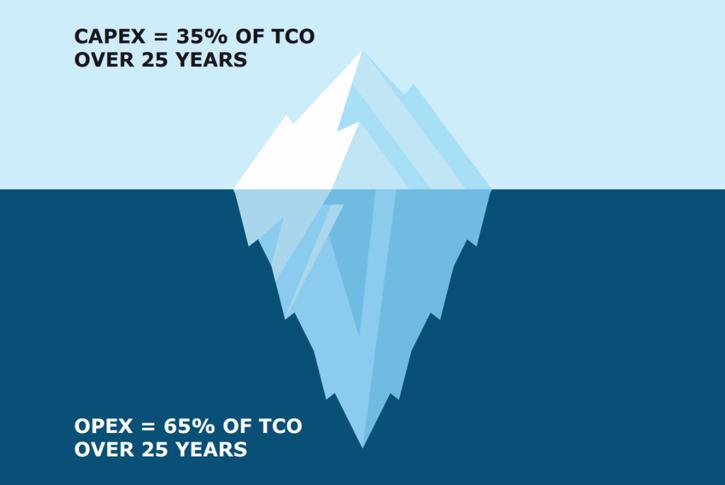
As we can see, CAPEX is only the tip of the TCO iceberg, representing 35% of total costs of ownership over the plant’s lifetime. Below the surface, OPEX constitutes the biggest share of TCO: no less than two-thirds.
Which CAPEX and OPEX costs matter most in TCO calculations for SWRO plants?
The short answer to the question above is, of course: all of them. By definition, TCO calculations must include all CAPEX and OPEX costs, leaving nothing out.
In practical terms, however, some costs matter more to TCO calculations than others because they are both discretionary and significant: owners and operators can choose between certain CAPEX options that have substantial consequences for OPEX.
As we pointed out in our blog, Understanding the cost drivers of SWRO, many SWRO costs can be considered mandatory, not discretionary, since they depend more or less directly on plant location and size. This includes major CAPEX costs such as civil engineering, equipment/materials, and permitting/development. The quality of the raw water, where and how intakes and outfalls are located relative to the plant, and environmental regulations also vary by location and dictate obligatory investments. OPEX costs such labor and electrical energy also vary widely worldwide and cannot be decided by plant owners or operators.
Everything else being equal, it costs what it costs to buy and develop a site and build a plant on it. So, while these location-dependent costs of course matter to TCO, and good procurement practices and negotiation skills are better than their opposites, there is not much one can do to change these mandatory costs in a significant way.
What can be changed is the SWRO plant’s energy efficiency. Energy consumption is OPEX’s biggest component, typically representing 60-65% of total lifetime operating costs. Discretionary investments, such as integrating energy recovery devices (ERDs) and high-efficiency high-pressure pumps into plant designs, significantly reduce energy consumption and at a relatively minor incremental CAPEX cost.
Small CAPEX investments can have a big impact on TCO
ERDs represent less than 2% of average total CAPEX costs but can save almost two-thirds of energy costs every year for 25 years. That’s a comparatively small price to pay for such significant savings, and isobaric ERDs are now the rule rather than the exception in all large- and medium-sized plants, and, increasingly, in small plants as well.
Likewise, owners and operators can, in many cases, choose high-efficiency high-pressure pumps to further reduce energy consumption, often by as much as 20-30% compared to less efficient alternatives. Since high-pressure pumps represent approximately 50-60% of an SWRO plant’s total energy consumption, such savings add up over the plant’s lifetime.
As the chart below from Global Water Intelligence demonstrates, just how much energy high-efficiency axial piston high-pressure pumps save (in combination with ERDs) depends on the size of the SWRO plant: the smaller the plant, the greater the energy-saving potential. But medium- and large-sized plants can also save significant amounts of energy with axial piston high-pressure pumps.
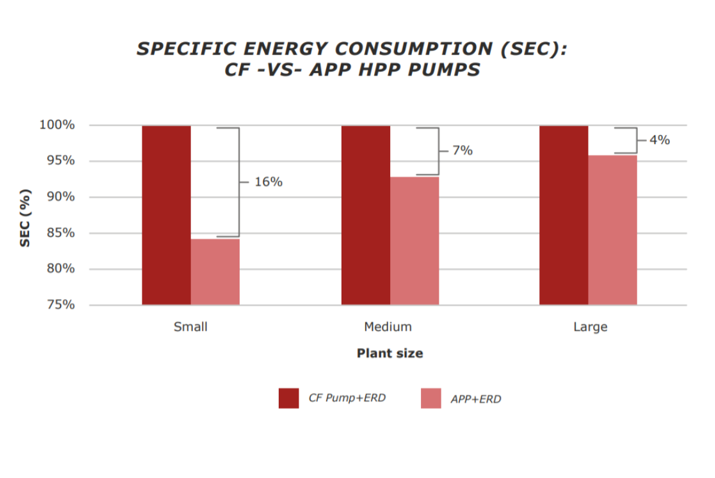
When calculated as part of the fictive 150,000 m3/day SWRO plant described above, it is clear that a relatively small incremental CAPEX investment in energy-efficient axial piston high-pressure pumps can have significant consequences for OPEX and TCO. Even if we peg the specific energy consumption savings at a very conservative 5%, over the plant’s lifetime (25 years), our fictional owners-operators would have €16 million more in the bank than they would if they had chosen centrifugal high-pressure pumps.
The total carbon costs of ownership matter, too
This blog has focused on the economic costs of SWRO. However, it is important to consider the environmental costs, too.
As we have discussed in previous blogs, The carbon footprint of potable water and A brief history of the energy intensity of desalination, although desalination has become far more energy-efficient in recent years it is the world’s most energy-intensive source of drinking water. Thus, it is relevant to examine not only the cost savings of energy efficiency but also the carbon savings.
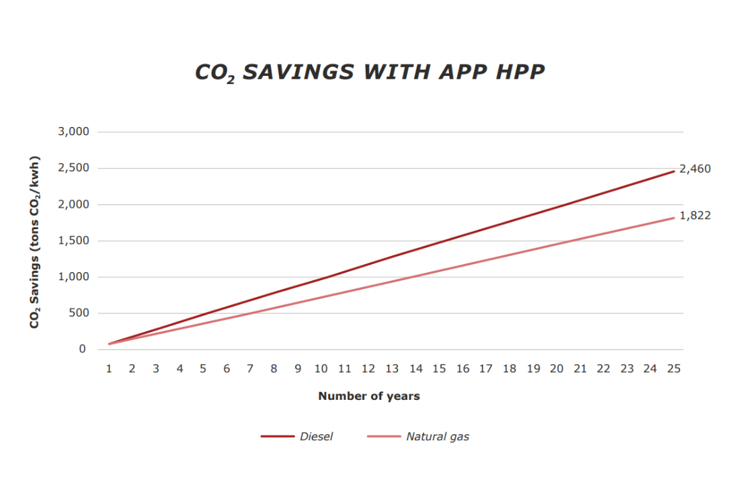
Energy optimization makes a huge difference to the carbon footprint of our 150,000 m3/day SWRO plant. As can be seen in the graph below, over the plant’s lifetime, an energy-optimized plant with ERDs and high-efficiency axial piston high-pressure pumps would save between 2,460 and 1,822 tons of CO2 depending on whether the plant gets its electricity from a power plant uses diesel or natural gas, as do many plants in areas where desalination is common.
That’s equivalent to driving around the equator 500 times in a diesel vehicle – another good reason to apply the TCO approach when considering the relative importance of CAPEX and OPEX.
Related blogs

Seawater reverse osmosis (SWRO) is growing worldwide to bridge the gap between increased demand and climate-driven water scarcity. However, compared to other sources such as ground and surface water, fresh water from SWRO is relatively expensive.

Our blog explores issues related to energy and cost efficiency in seawater reverse osmosis (SWRO). We’re investigating more topics and adding new blogs regularly.

Although just one percent of worldwide water consumption currently derives from desalinated seawater, desalination is responsible for an outsized share of water treatment’s global energy usage.
Read more about our solutions for desalination
The first active ERD for medium and large plants, the MPE 70 integrates highly effective isobaric pressure exchangers with a low-voltage motor to eliminate the risk of rotor overspin, reduce mixing and biofouling, and facilitate smarter automation. Covering train sizes from 1,500 m3/day and above.
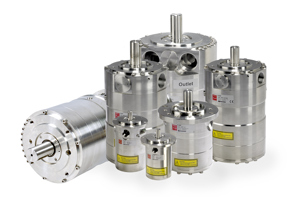
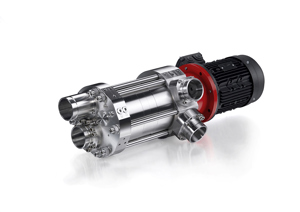
The range of high-pressure APP pumps is optimized for both landbased, off-shore and marine sea water reverse osmosis applications. Available with or without motor.
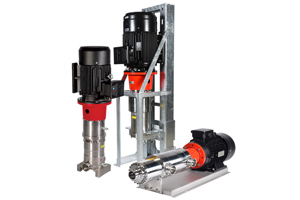
With a 3-in-1 design that integrates highly effective isobaric pressure exchangers with positive displacement booster pumps and electrical motors, active iSave® ERDs deliver big energy savings in small spaces. Covering train sizes from 200-3,000 m3/day
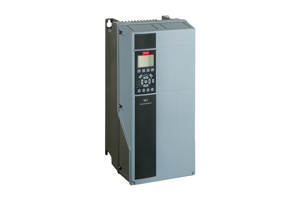
VLT® AQUA Drive FC 202 controls all types of pumps and comes equipped with a cascade controller.
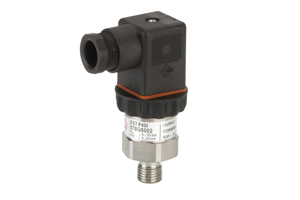
For use in corrosive environments and with aggressive media, Danfoss offers the robust DST P40I pressure transmitter made of Titanium and with ceramic pressure sensing element. DST P40I is optimized for use in applications such as desalination systems, seawater cooling, and chemical processing.
Explore our case stories

In addition to a fast design and installation, the customer's needs for energy efficient solutions were met by using pumps and energy recovery devices from Danfoss.

Low maintenance costs alongside very low energy costs have resulted in extremely competitive total costs of ownership for the entire RO plant

Krosys is a leading Korean firm with long experience in SWRO systems. Krosys had no doubt that the APP pumps from Danfoss would be the most energy efficient way to transform the "lava water" into fresh Water at the Korean Jeju Island.
INEXA is a specialist in energy-efficient desalination, drinking water treatment, water distribution and waste water treatment. Based in Las Palmas de Gran Canaria, Spain, the company pioneered an innovative system of energy audits designed specifically for water treatment and desalination applications, and has since leveraged its energy expertise in engineering and plant construction projects around the world

Even though Canaragua has installed dozens of SWRO plants throughout the Canary Islands, the project in Puerto de Mogán was unusual because of the focus on compactness. The municipality needed to expand water production, and the best place to locate the new plant was in the middle of the historic town right off the main square.
Follow us to stay up with the latest high news, updates, announcements, and resources from High Pressure Pumps. Of course, we want to hear from you too - so jump in and join the conversation.