
Danfoss conducts business and creates financial results in an ethical manner. We are committed to upholding international human rights throughout our business operations. Our policies ensure that business ethics, proper working conditions and anti-corruption are core elements of our company’s behaviors.
Business ethics
Sustainability and ethical behavior are integral parts of our DNA. The respect for human rights, proper working conditions, and social and environmental considerations are integral parts of our identity.
Since 2002, Danfoss has been part of the UN Global Compact and its 10 principles for responsible business behavior. We are committed to aligning our business practices with the UN Guiding Principles for business and human rights.
Ethical guidelines and governance
We have implemented comprehensive compliance programs with mandatory training to minimize the risk of ethical non-compliance. The programs define clear ownership, and policies, including the Danfoss Ethics Handbook and Policies on Danfoss Business Conduct. Danfoss also conducts mandatory training on ethics, export control, fair competition, anti-corruption, and data privacy. For each topic, a target group is defined to cover all colleagues who have touchpoints with the respective subjects.
The Danfoss Board of Directors is responsible for oversight of ethics and compliance, and our Audit Committee assesses the effectiveness of the compliance programs. Responsibility for day-to-day ethics and compliance activities is anchored with the respective business segments and functions.
In addition, regular compliance awareness communication is provided to refresh colleagues on the ethical guidelines in our ethics handbook.

Whistleblower function
The Danfoss Ethics Hotline serves as our whistleblower function and grievance mechanism for human rights. It is hosted by an external operator, ensuring that colleagues and external stakeholders can report violations of legislation or internal ethics guidelines anonymously without risk of retaliation. In 2023, our whistleblower setup was updated to meet the requirements of the European Whistleblower Protection Directive.
Data privacy and data ethics
As processes in Danfoss become increasingly digitalized, we maintain a high focus on data privacy processes and compliance with data privacy regulations. We adhere to our Data Privacy Handbook, conduct training, and comply with data privacy legislation where we operate. Danfoss applies the same ethical values and guidelines to the processing of all data across the organization, going beyond compliance with data privacy legislation.

Danfoss has a whistleblower-function, Ethics Hotline, where you anonymously can report concerns or suspicions about violations of Danfoss ethical guidelines, criminal actions or human rights violations. The reporting line is open to employees, business partners and other impacted parties.
Additionally, employees can contact ‘AskEthics’ if they need advice on how to handle a difficult situation related to business ethics or how to apply company policy on a specific situation.
Go to the Ethics Hotline

Danfoss human and labor rights program
At Danfoss, human and labor rights have always been a priority. We believe that human rights are about respecting and promoting the dignity of all people. Since our founding in 1933, Danfoss has embraced a strong sense of social responsibility. Supporting our people and their families, as well as local communities, has been a fundamental part of who we are, shaping the way we operate and grow.
We recognize our business responsibility and are deeply committed to ensuring respect for and promotion of human and labor rights across our value chain. Our human rights due diligence process is guided by the UN Guiding Principles (UNGPs) and the OECD Guidelines for Multinational Enterprises which prescribe a risk-based, continuous approach to identification, assessment and mitigation of adverse human rights impacts across the value chain. Based on our due diligence efforts conducted to date, we have identified a list of salient human rights – i.e., human rights with a heightened risk of potential severe adverse impacts occurring – which has formed the base of our human rights program. The program rests on 3 pillars:
Human rights due diligence
Danfoss is committed to the UN Guiding Principles for Human Rights, which entails that we must carry out a human rights’ due diligence process where potential or actual human rights impacts are identified. To fulfil our responsibility, we continuously conduct human and labor rights due diligence and have further embedded human and labor rights considerations into various processes across different business functions, e.g., HR, procurement, sales, product compliance, real estate, or mergers and acquisitions. Any identified impacts are assessed, prioritized, and mitigation actions are put in place.
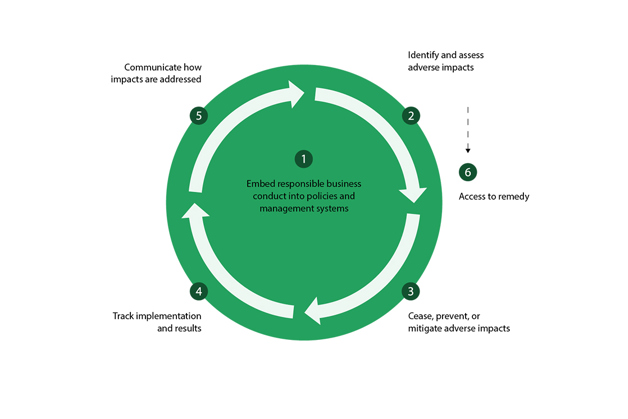
The Danfoss human rights due diligence process follows a risk-based approach and is structured around the steps listed in the picture below. It is an ongoing process and any lessons learned are used to improve the existing processes and content of our policies.
As part of our due diligence, we engage with various stakeholder groups across our value chain. This includes our own employees, workers in value chain, and several multistakeholder initiatives. For example, we engage and participate in the UN Global Compact Network Denmark and the Nordic Business Network for Human Rights, coordinated by the Danish Institute for Human Rights. These multistakeholder networks represented by human rights experts enable us to deep dive into the issues we have identified as salient for our business; connect with peers and foster collaboration and knowledge sharing with other Nordic businesses dealing with similar challenges.
Mitigating modern slavery
Modern slavery is an umbrella term that covers forced labor, servitude, and human trafficking, as well as work performed involuntarily or under any threat of penalty. Danfoss fully acknowledges the gravity and extent of modern slavery instances happening globally every day, and that the private sector plays a critical role in eliminating this challenge. In line with the UN´s goal of abolishing forced labor, modern slavery, and human trafficking by 2030, we are resolute in our responsibility to conduct business ethically and are committed to being a driving force for positive change in our value chain.
As part of our due diligence process, we analyze the inherent modern slavery risks across our value chain. Following a risk-based approach, we have identified few materials and services in our upstream value chain with increased risk. Recruitment remains one of the sectors with the highest risk of forced labor in our value chain. As part of our contractual compliance, as well as our supplier due diligence toolbox, we ensure that our suppliers do not use or benefit from forced labor.
Responsible supplier management
A stable, sustainable, and transparent supply chain is fundamental to Danfoss’ operational success and our ability to deliver on our commitments. Across our three segments, we continuously work to mitigate supply chain risks and build strategic, value-adding relationships with our suppliers. This approach is anchored in two core elements: 1. contractual compliance, and 2. continuous due diligence we conduct throughout the supplier lifecycle management.
- The Danfoss Supplier Code of Conduct establishes specific environmental, social, and ethical business requirements for our suppliers. These requirements are guided by the Ten Principles of the United Nations Global Compact, the UN Guiding Principles on Business and Human Rights, the OECD Guidelines for Multinational Enterprises, and relevant conventions of the International Labor Organization (ILO). The Code covers the scope of the Responsible Business Alliance´s (RBA) code of conduct.
- The supplier due diligence process starts with risk screening, and where relevant, it is followed by supplier self-assessments and ultimately second- or third-party audits. The verification is triggered when onboarding a new supplier. Further, existing suppliers are reassessed on a regular basis.

Conflict and responsible minerals
Danfoss supports the efforts of governments and organizations to end violence and atrocities in conflict-affected areas. We are committed to sourcing materials and components from companies that also share our values regarding human rights, ethics, and environmental responsibility.
To ensure regulatory compliance, we engage with our suppliers regularly and support the Responsible Minerals Initiative, reviews. We run recurring campaigns to acquire supplier information on conflict minerals, including smelter/ refiner identification and country of origin. This has enabled us to provide conflict mineral reporting templates to our customers. Danfoss has also partnered with a third party to collect conflict minerals reporting templates (CMRT) from suppliers and conducts smelter due diligence campaigns.
Handling Human Rights complaints

If you decide to file a complaint, we ask you to include a description of the relevant facts (including names of alleged victims or otherwise adverse negatively impacted parties, dates, location and other evidence), with as much detail as possible.
Shortly after you’ve filed a complaint, we will send you confirmation, that we’ve received your complaint.
The goal for the initial proceedings is to reach a mutual understanding of the complaint and ensure, that all formal legal requirements to handle the complaint are met.

Danfoss will in co-operation with the affected parties try to collect all available and relevant information.
You can expect to be asked to send all relevant information that will shed light on facts or identify information, which needs to be collected.
The collected information will be presented to you before it is decided which actions Danfoss will take to address your complaint.

In situations where Danfoss has caused or contributed to an adverse impact, Danfoss is committed to providing reparation for harm suffered to redress any violations.
The reparation will be assessed on a case-by-case basis to ensure that it is proportional to the gravity of the violations and the specific circumstances of each case.