Danfoss Impact No. 6
Our latest Impact paper provides a clear guide on how companies can strengthen their competitive advantage through decarbonization, electrification, and energy efficiency.
Download the Impact paper now
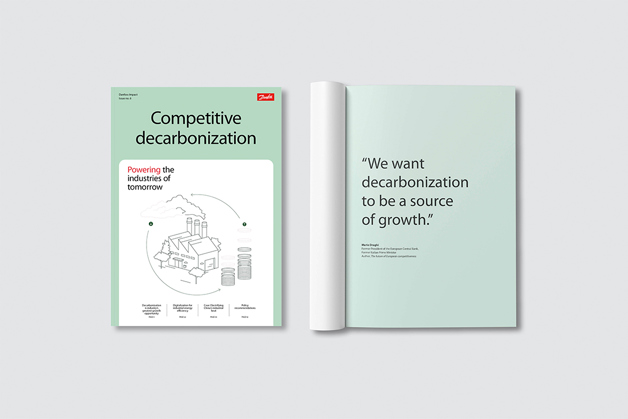
More and more companies around the world are already turning the challenge of decarbonization into a powerful driver of value creation and competitive advantage. Yet existing policies do not sufficiently support industrial decarbonization efforts. This issue of Danfoss Impact provides a clear guide for companies to strengthen their competitive advantage through decarbonization and demonstrates how a political framework can accelerate the transition.Industry has a unique role to play in the battle against climate change, as many of the essential goods it produces – such as critical minerals, electric vehicles, and sustainable building materials – are core pillars of the green transition. By embracing the innovative solutions and technologies that already exist today, industry can turn the greatest challenge of our time into its greatest growth opportunity.
When it comes to building resilience to fluctuating energy costs, manufacturing industries could almost double the gross value added from each unit of energy use by 2040 by adopting cost-efficient energy efficiency measures.

The industrial sector accounted for roughly one-third of global energy consumption in 2022, with an expected annual increase of 1.4% through 2030. But to reach net zero by 2050, total industrial energy use must grow by less than 0.5% per year by 2030.

Renewable energy sources such as wind and solar produce electricity. To prepare for the future renewable energy system, companies must therefore electrify wherever possible. Estimates show that existing technology can electrify 78% of industrial energy use, with the possibility of reaching 99% electrification with technology already in development.

By 2030, up to 53% of the world’s energy input will be wasted as excess heat. By strategically integrating processes and sectors, this excess heat can be reused in factories to produce heat and hot water, by other consumers close by through industrial microgrids, and even be sold into local district energy grids, providing low-emissions heating for buildings and water in the area.
Decarbonization is a powerful driver of value creation and competitive advantage in industry.

By signing up for our newsletter, you will receive updates on the latest insights on competitive decarbonization.
The IEA’s Industry Tracker still labels the industrial sector as “not on track” for a net-zero scenario. However, the opportunity to take a major leap forward is imminent. Existing policies only provide limited support for electrification and decarbonization, but by simplifying excessive red-tape regulation and implementing the right policy framework, industrial decarbonization can finally take off.
Tax benefits will go a long way in incentivizing industry’s green transition and are oftentimes easier to navigate and require less bureaucracy than subsidy programs. For instance, the US Inflation Reduction Act (IRA) includes a range of tax provisions, which bring down the cost of the green transition for consumers and industry. These tax credits are simple levers to increase the appeal of committing to climate-friendly technologies without compromising profitability. As seen with the US IRA, utilizing tax credits can increase competitiveness, create more jobs, and lower consumer electricity bills.
Read more here.
A level playing field will allow for more stakeholders to engage in the green transition. Creating a level and competitive market requires that equal opportunities and regulations ensure that market players are held to a certain standard. With the EU Energy Efficiency Directive, the union has regulated the ways in which companies must conduct energy audits and management. Depending on energy use and size of enterprise, companies must carry out an energy audit or implement an energy management system (EMS). However, only the EMS comes with obligatory implementation of energy-saving measures. Mandating more entities at all levels to carry out energy audits and implementing EMS would see companies utilize “low-hanging fruit” measures with short payback times and realize great savings potentials.
Political ambitions function as guidelines for the industry to follow, and they are important measures to accelerate and ensure stakeholders’ willingness to invest in the green transition. Uncertainty in political resolution and direction will create too many risks for industrial actors. Ever-changing market regulations decrease reliability and prevent stakeholders from long-term planning. Therefore, it is important to set the right, ambitious targets, mitigating the tendency to take on stop-and-go policies. Policymakers must focus on creating certainty, resilience, and security, ensuring diplomatic ties and supply chains are not held up by bottlenecks endangering the progress towards the Paris goals.
Special Issue
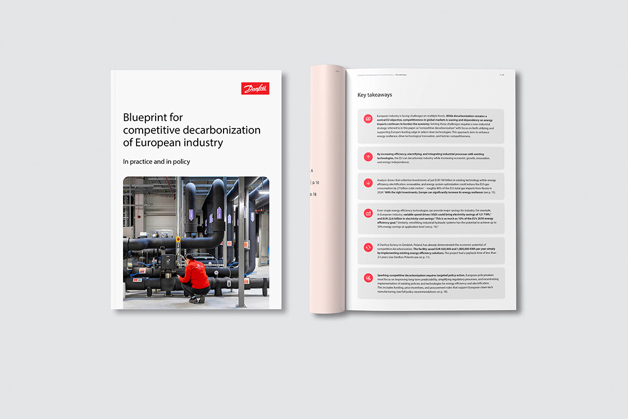
By increasing efficiency, electrifying, and integrating industrial processes with existing technologies, the EU can decarbonize industry while increasing economic growth, innovation, and energy independence.
Read more
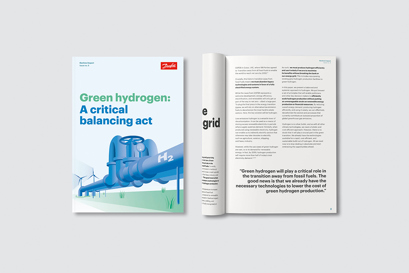
Green hydrogen will play a critical role in the transition away from fossil fuels and in decarbonizing hard-to-abate sectors, such as long-distance shipping and international aviation.
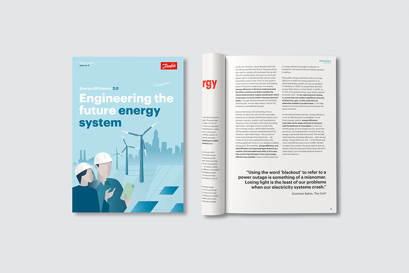
Energy efficiency, electrification, demand-side flexibility, conversion, storage, and sector integration are integral for a future energy system enabling an energy grid powered by renewables.
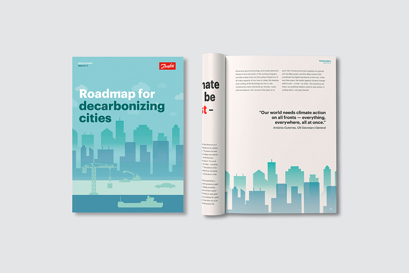
Our roadmap for decarbonizing cities outlines the technologies available to meet global climate goals and accelerate the green transition.