
Danfoss Impact No. 3
Our roadmap for decarbonizing cities outlines the technologies available to meet global climate goals and accelerate the green transition.
Download the Impact paper now
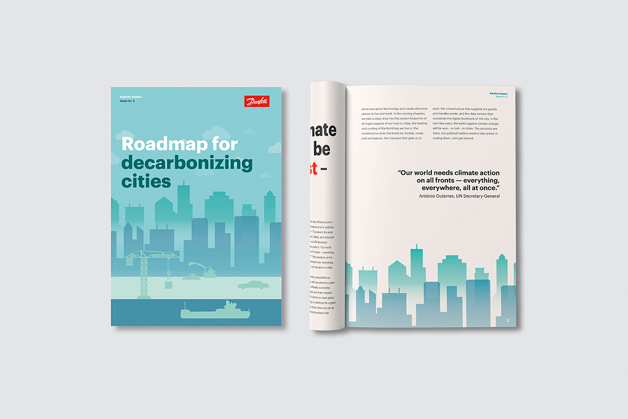
The battle against climate change will be won – or lost – in cities
Cities account for two-thirds of global energy consumption and more than 70% of annual global carbon emissions. With more than half of the world’s population living in cities today – a number expected to increase to almost 70% in 2050 – we will not reach the goals of the Paris Agreement without a deep decarbonization of cities.
The most recent IPCC report exposed that the 1.5°C target is moving out of reach, and it’s likely that the world will exceed 1.5°C of warming in the near term if we “keep walking instead of sprinting.”
Climate change has already resulted in negative impacts on human well-being and key infrastructure in cities. To prevent the worst of the climate crisis, rapid, deep, and sustained change is necessary.
Cities offer some of the best possibilities to optimize urban planning and accelerate a green transition, and there are already accessible, cost-efficient technologies capable of cutting emissions sufficiently to meet global climate goals.
The solutions are there, but political leaders need to take action to scale them.

Only got two minutes?
These are the key takeaways

If all urban areas and cities in Europe, the US, and China invested in energy-efficient heating and cooling of buildings, this would contribute 20% of the emissions reductions needed in urban areas to reach the 1.5°C target of the Paris Agreement.

If all urban areas and cities in Europe, the US, and China electrified their private and public transport, this would contribute 28% of the emissions reductions needed in urban areas to reach the 1.5°C target of the Paris Agreement.

Sector integration is an enabler of energy efficiency and electrification, and can, together with the build-out of renewables, decarbonize the power supply to cities. Supermarkets, data centers, and wastewater facilities can all be turned from heavy energy consumers into energy suppliers.

Implementation of existing technology for buildings, transport, and sector integration can bridge half the gap in the urban GHG emissions reductions needed for a 1.5°C pathway.
Policy recommendations
Danfoss Impact Series
This Impact paper provides a clear guide on how companies can strengthen their competitive advantage through decarbonization, electrification, and energy efficiency.
Green hydrogen will play a critical role in the transition away from fossil fuels and in decarbonizing hard-to-abate sectors, such as long-distance shipping and international aviation.
Energy efficiency, electrification, demand-side flexibility, conversion, storage, and sector integration are integral for a future energy system enabling an energy grid powered by renewables.