R404A/R507A replacement: Your main questions answered
In Europe R404A and R507A refrigerants are already banned in many new refrigeration equipment and for service only recycled refrigerants can be used. Here is a list of replies to the many questions we have received related to the best refrigerants to replace R404A / R507A in refrigeration applications, to the impact on the system performance, on the components and their availability, and to the best practices.
Commercial Refrigeration applications are very diverse regarding systems types and refrigerants used. It includes cold rooms, glass door merchandisers, and display and islands cabinets, either in centralized or plug-ins – hermetic or autonomous cooling circuits with condensing units. Commercial Refrigeration applications are grouped into three main categories: hermetically sealed applications, condensing units and centralized DX systems.
While Europe leads with CO2 refrigerants, other regions must urgently phase out high GWP gases like R-404A. Our expert paper provides insights and strategies to help you transition to natural refrigerants, boost energy efficiency, and improve maintenance practices. Read our expert paper to start the journey to make a positive environmental impact and enhance your operational resilience.
Read the expert paper

What is the most cost-effective way to upgrade an R404A cold room?
Upgrading an existing R404A cold room raises a practical question: is it more cost-effective to switch refrigerant, upgrade the controls, or replace the compressor?
For many existing cold rooms, a refrigerant's retrofit and control optimization may be evaluated before replacing major hardware. Lower-GWP A1 refrigerants such as R448A or R449A may be suitable replacement options for some R404A systems, but the system must be checked for compressor approval, valve settings, safety controls, component sizing, discharge temperature, refrigerant charge, and operating conditions. When a retrofit is properly engineered and commissioned, switching from R404A to R448A or R449A can improve system COP by approximately 5–10% in some existing cold room applications.
Energy savings should not be assessed from refrigerant choice alone. In many cold rooms, the strongest return comes from combining the refrigerant transition with controls upgrades such as improved temperature control, floating head pressure, fan speed control, and better system monitoring.
Cost-effectiveness comparison: refrigerant switch vs controls upgrade vs compressor replacement
| Upgrade option | Typical cost level | Energy-saving potential | Best fit | Payback expectation |
|---|---|---|---|---|
| Refrigerant switch from R404A to R448A or R449A | Low to medium | Depends on system design, operating conditions, and setup after retrofit | Existing systems where the compressor, valves, controls, and components are qualified for the replacement refrigerant | Usually strongest when done for compliance, refrigerant availability, or lifecycle planning — not energy savings alone |
| Controls upgrade | Low to medium | Often strong because controls affect daily operating behaviour, defrost, fan operation, pressure control, and monitoring | Systems with outdated controls, fixed settings, poor defrost strategy, or limited monitoring | Often one of the fastest practical ROI paths, especially where the system runs many hours per year |
| Compressor replacement | Medium to high | Can be high if the existing compressor is inefficient, oversized, unreliable, or near end of life | Systems with ageing compressors, recurring faults, poor efficiency, or incompatible refrigerant strategy | Usually longer payback unless replacement is already needed for reliability, efficiency, or compliance |
| Full system redesign | High | Highest potential when the existing system is outdated or no longer suitable | Major refurbishment, capacity change, new refrigerant strategy, or long-term compliance planning | Best evaluated as a lifecycle investment rather than a simple short-term payback |
Can switching from R404A to R448A or R449A can improve system COP by 5–10% in existing cold rooms?
When a retrofit is properly engineered and commissioned, switching from R404A to R448A or R449A can improve system COP by approximately 5–10% in some existing cold room applications.
Is it worth switching refrigerant just for energy savings, or only when forced by regulation?
Switching from R404A to a lower-GWP refrigerant is often driven by a combination of regulatory requirements, refrigerant availability, long-term service planning, operating costs, and environmental goals. Energy savings can be part of the business case, but the results depend on the refrigerant selected, operating conditions, compressor approval, expansion valve setup, controls, and overall system design.
For many existing cold rooms, a refrigerant retrofit may be evaluated alongside controls optimization before major equipment replacement is considered. Lower-GWP refrigerants such as R448A and R449A have been used as retrofit options for R404A systems and may improve efficiency in some applications when the retrofit is properly engineered and commissioned. Before switching refrigerant, installers should verify compressor and condensing unit approval, expansion valve settings, controller settings, safety controls, discharge temperature, refrigerant charge, filter driers, sight glasses, and overall component sizing to help ensure reliable operation.
What are the best refrigerants to replace R404A in any application?
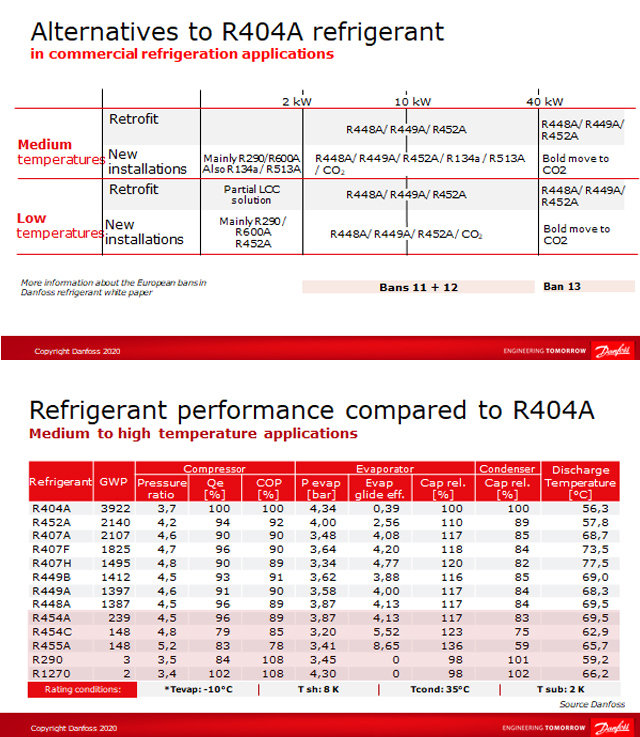
What are the best replacements for R404A / R507A that I can use in medium temperature applications, now and in the future?
- There are several viable options which depend on the application, operating conditions, and whether it will be used in a new or existing system. In centralized systems, CO2 has become a viable refrigerant and can be used in different system setups.
- In existing systems mid-size refrigeration applications, between 2 to 40 kW, we recommend R448A, R449A or R452A. The same applies for new installations at medium temperatures, including R134a. We can see A2L-R454A, R455C and R1234yf emerging for new systems.
- For smaller refrigeration systems, below 2 kW, R134a and R1234ze are well established as well as hydrocarbons (R600a and R290) offering high efficiencies.
What are the best refrigerants to replace R404A / R507A in low-temperature applications?
In new low-temperature systems below 2 kW, propane (R290) is an interesting, long-term option, depending on the refrigerant charge needed.
For the existing mid-size systems, R448A, R449A and R452A are good options with moderate GWP levels while emerging A2L-R455A, R454C and R1234yf should only be applied in new systems.
In larger systems, the same apply on top of the CO2 option.
Link to the HC pages / CO2 pages
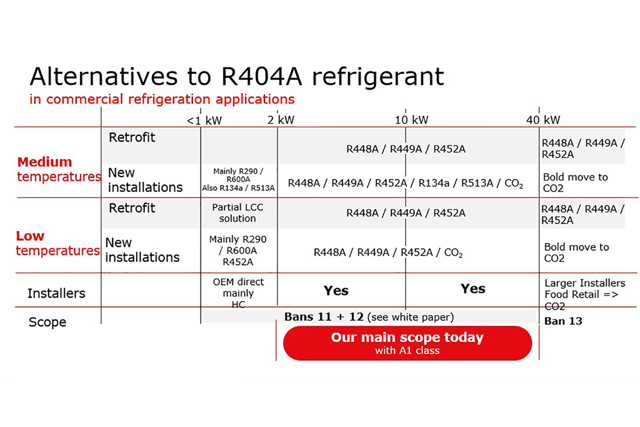
In new systems, what are the best refrigerant options for commercial medium and low temperature equipment/installations?
The best options depend on the unit’s size and type.
In centralized systems common in supermarkets and hypermarkets, CO2 is the main ultra-low GWP and natural refrigerant used in new equipment. A lot of progress has been made to enhance its efficiency – even in high ambient temperatures. It also complies with Article 13 usage and service ban of the EU F-gas regulations.
In small installations such as glass door merchandisers (GDMs), depending on the application temperature, new systems should preferably use hydrocarbons for high performance, which relate to Article 11 of the EU F-gas regulations.
In mid-size installations such as cold rooms, milk tanks, display cabinets, and blast freezers, there are several options which relate to Article 12 of the EU F-gas regulations. The best choice will depend on the type of application.
For further information, please refer to question 1.
-> For more information about the impact on system performance and components, access the Retrofit Tool in Coolselector.
Is R449A or R452A better for low temperatures (LBP)?
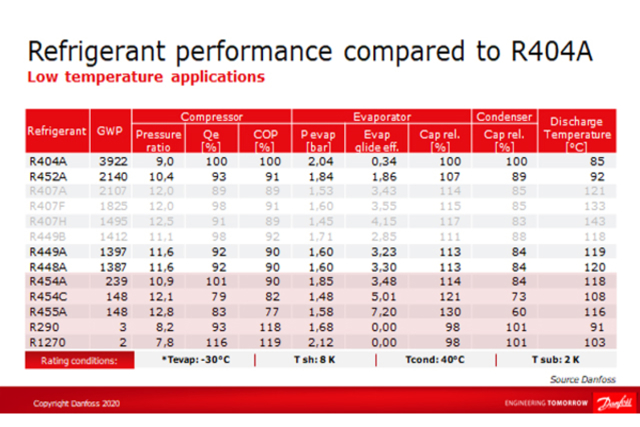
It depends entirely on the application. In low temperature applications, R452A provides a wider operating map without additional system components – such as for vapor injection – and unables a simpler design.
R448 and R449A deliver good energy performance and have a lower GWP than R452A.
Each refrigerant complies with Articles 11 (self-contained units), 12 (condensing units), and 13 (centralized systems) usage and service ban of the EU F-gas regulations.
However, it’s important to remember that under Article 11, none of these refrigerants can be used in self-contained units after 2022.
Even more important than the bans, the F-Gas regulation requires our industry to reduce the GWP level of all refrigerants used in general by means of a quota system on high GWP refrigerants until 2030 . Several A2L refrigerants (e.g. R454A/C, R455A) offer very low GWP levels and are suitable for new low temperature refrigeration systems.
-> For more information about the impact on system performance and components, access the Retrofit Tool in Coolselector.
What impacts does a new refrigerant have on system performance?
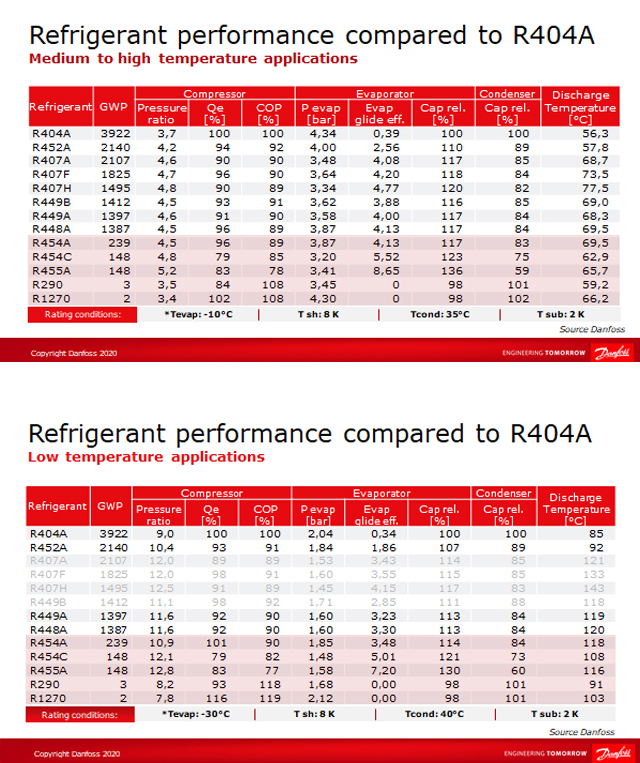
You will notice similar efficiency and cooling capacity when switching from R404A to R448/449A or R452A.
However, if you select the correct piping, settings, valve dimensions, and condensing and evaporating sizes, it’s possible to improve seasonal and part-load efficiency in new installations.
On top of the A1 class and natural refrigerants, A2L refrigerants offer even higher GWP reductions with good performance and efficiency.
The refrigeration systems need to be designed to comply to the requirements for flammable refrigerants. Please only use components which are approved for your specific refrigerant. To ensure best performance and reliable operation of your new A2L installation, please use Coolselector for component and pipe size selection.
-> For more information about the impact on system performance and components, access the Retrofit Tool in Coolselector.

About component selection and best practices
What’s best practice when I need to replace R404A / R507A with another refrigerant in an existing installation or piece of equipment?
Standard best practices in Europe are detailed in the EN 378-1:2016 standard, Pressure Equipment Directive (PED) 97/23/EC, and Electromagnetic Compatibility (EMC) Directive 2014/30/EU.
Appropriate leak control and detection are also required in retrofits for traceability.
!!! Please note that only A1 class refrigerants should replace R404A, R507A or R134a in an existing system. A2L and A3 should never be used for retrofit in an installation using a A1 refrigerant.
What about compressors and selection of refrigerants generating high discharge temperatures?
For recommended low and medium temperature refrigerants, refer to question 1.
In all circumstances, use compressors with the refrigerants they are approved for.
Due to the thermodynamic properties of R448A and R449A, both have high discharge temperatures, which will limit the operating map of any compressor.
To increase the operating map, vapor or liquid injection are required. However, both are more expensive options.
Should compressor oil be changed at the same time as refrigerant?
First of all, use compressors only with the refrigerants they are approved for.
It’s important to ensure that system oil is compatible for each component and every alternative option.
Danfoss POE oil must be used with any Danfoss commercial compressor, including subsequent future models. When changing oil, it’s also a good opportunity to change the filter dryer. to help ensure system longevity.
-> Reciprocating compressors use Danfoss POE oil from 160 to 175 PZ
Scroll compressors no longer use PVE oil and now use POE oil.
When replacing R404A / R507A in low temperature applications, is there a maximum operating pressure (MOP) valve for R452A?
-> We do have such valves.
There are TU, T2 and TE valves for R452A with MOP available.
You can find all relevant information at Coolselector.danfoss.com
Components qualified for new refrigerants
When I replace R404A / R507A with another refrigerant in an existing installation or piece of equipment, are the components for R404A – such as TXVs, compressors, solenoid valves, and filters – compatible with the new refrigerants?
Due to the refrigerant properties, not all components will necessarily be compatible with new refrigerant. Especially when it comes to flammable refrigerants.
To help match the right components to each refrigerant, refer to the Danfoss Coolselector®2 calculator and Danfoss technical data sheets. Coolselector versions after October 2019 include a Retrofit Tool that provides details about the impact on each system components.
When will Danfoss release R449A/R448A and R452A-compatible compressors for use in low temperature applications?
Light commercial compressors are already available for R448A, R449A and with R452A. In addition, our range of scroll compressors are also compatible with these refrigerants for both medium and low temperature applications but with liquid injection.
Danfoss Maneurop reciprocating compressors won’t be available for R448/R449A as the operating map is smaller than for R404A / R507A.
Instead, we recommend using R452A – which is the same advice given by all reciprocating compressor manufacturers.
Ongoing qualification for A2L-ultra-low GWP refrigerants are planned for most of the models such as NTZ 1 cylinder reciprocating compressors, LLZ scroll compressors.
-> For more information, see at Coolselector.danfoss.com
Can R404A / R507A -compatible valves be used with new refrigerants?
-> It depends on the type of refrigerant.
Due to the refrigerant properties, not all components will necessarily be compatible with new refrigerant. This is particularly sensitive with A2L alternatives to R404A.
To help match the right components to each refrigerant, refer to the Danfoss Coolselector®2 calculator and Danfoss technical data sheets.
Which valve components – such as O-rings and gaskets for example – are compatible?
All material Danfoss uses are compatible with the refrigerants the product - e.g. an expansion valve - is approved for.
Refrigerants not approved for a product might not be compatible with some of the raw material e.g. polymers in this product.
For a save and reliable operation, please make sure the products you use are approved for the refrigerant in your system.
To see valve compatibility with refrigerants, check in Coolselector®2
For retrofit, read our retrofit guideline.
R404A replacement options for walk-in coolers and cold rooms
For existing R404A walk-in coolers and cold rooms, R448A, R449A, and R452A are common lower-GWP retrofit options. These refrigerants can reduce the global warming potential compared with R404A, while allowing many existing systems to remain in operation where the compressor, condensing unit, valves, controls, oil, gaskets, and line components are compatible.
The right retrofit choice depends on the application, temperature range, compressor approval, operating envelope, discharge temperature, expansion valve setup, refrigerant charge, and component sizing. Before changing refrigerant, installers should always check the system design and component compatibility rather than treating any alternative refrigerant as a universal drop-in replacement.
GWP comparison: R404A and lower-GWP retrofit options
| Refrigerant | Safety class | GWP | GWP reduction vs R404A | Typical retrofit relevance |
|---|---|---|---|---|
| R404A | A1, non-flammable | 3943 | Baseline | Legacy refrigerant used in many existing commercial refrigeration systems |
| R448A | A1, non-flammable | 1273 | About 68% lower | Common lower-GWP option for medium-temperature and selected low-temperature applications |
| R449A | A1, non-flammable | 1282 | About 67% lower | Common lower-GWP option for medium-temperature and selected low-temperature applications |
| R452A | A1, non-flammable | 2140 | About 46% lower | Often considered for low-temperature applications where operating envelope and discharge temperature are key concerns |
Walk-in cooler and cold room retrofit checklist
Before retrofitting an R404A walk-in cooler or cold room to a lower-GWP refrigerant, complete these checks:
- Confirm compressor or condensing unit approval
Check whether the compressor or condensing unit is approved for the selected replacement refrigerant and whether the operating map fits the application. - Verify TXV and expansion device compatibility
Check whether the thermostatic expansion valve can be adjusted for the new refrigerant or whether a new valve, orifice, or bulb charge is required. - Check oil compatibility
Confirm that the compressor oil is compatible with the selected refrigerant. If required by the compressor manufacturer, change to an approved oil type before operation. - Adjust superheat settings
Set and verify superheat after the refrigerant change. Superheat adjustment is critical because the new refrigerant may change evaporator behavior and valve response. - Adjust safety switches and controller settings
Review pressure switches, safety controls, controller parameters, and refrigerant-specific settings to match the new operating pressures and temperatures. - Check discharge temperature limits
Verify that compressor discharge temperature remains within the approved operating range for the selected refrigerant and application. - Replace the filter drier and sight glass
Change the filter drier and sight glass as part of good retrofit practice to help protect the system and support longer system lifetime. - Check component sizing
Review the expansion valve, solenoid valve, evaporator, condenser, pressure regulator, check valve, compressor or condensing unit, and refrigerant lines for correct sizing and operating conditions. - Check refrigerant charge and system cleanliness
Recover the old refrigerant properly, clean the system where required, and charge the new refrigerant according to the relevant service procedure and manufacturer guidance. - Verify performance after commissioning
After startup, check operating pressures, superheat, subcooling, discharge temperature, compressor operation, cooling capacity, and room temperature stability.
Which R404A replacement refrigerant should I choose?
| Application situation | Recommended direction |
|---|---|
| Existing medium-temperature cold room | Start by checking R448A or R449A compatibility. |
| Existing low-temperature freezer room | Check R448A, R449A, or R452A depending on compressor approval, operating envelope, and discharge temperature. |
| Existing system with qualified condensing unit | A refrigerant retrofit may be possible with system checks and setting adjustments. |
| Existing system not qualified for the new refrigerant | Component replacement, redesign, or new equipment may be required. |
| New commercial refrigeration installation | Consider the full refrigerant strategy, including lower-GWP A1 options, A2L options, CO₂, or other approved pathways depending on application and local regulations. |
R404A retrofit in walk-in coolers and cold rooms

What is the best refrigerant to replace R404A in an existing walk-in cooler?
For existing walk-in coolers using R404A, R448A and R449A are common A1 lower-GWP retrofit options. They are often considered for medium-temperature commercial refrigeration systems where the existing compressor, condensing unit, valves, controls, and other components are compatible.
Before selecting the replacement refrigerant, installers should check compressor approval, operating envelope, expansion valve setup, oil compatibility, safety controls, discharge temperature, and component sizing.
Can I replace R404A with R448A or R449A without changing equipment?
R448A or R449A may be used in some existing R404A systems if the condensing unit and system components are already qualified for the replacement refrigerant. However, they should not be treated as universal drop-in replacements.
Even when no major equipment change is required, the system still needs checks and adjustments, including compressor approval, expansion valve settings, safety switches, controller settings, filter drier replacement, sight glass replacement, and performance verification.
Is R452A a good replacement for R404A in low-temperature applications?
R452A can be considered for some low-temperature applications, especially where operating envelope and discharge temperature are important selection factors. However, it has a higher GWP than R448A and R449A, so the final choice should balance operating conditions, compressor approval, system performance, and regulatory requirements.
What should I check before retrofitting R404A to a lower-GWP refrigerant?
Before retrofitting R404A to a lower-GWP refrigerant, check compressor or condensing unit approval, operating map, oil compatibility, gasket compatibility, TXV or expansion valve setup, safety switch settings, controller settings, discharge temperature, filter drier, sight glass, refrigerant charge, and component sizing.
Do I need to adjust the expansion valve when changing from R404A?
Yes, the expansion valve may need adjustment or replacement when changing from R404A to another refrigerant. Installers should verify the valve capacity, superheat setting, bulb charge, and operating behavior after the retrofit.
Why does discharge temperature matter when replacing R404A?
Discharge temperature matters because some replacement refrigerants can increase compressor discharge temperature compared with R404A. If discharge temperature rises above the approved compressor operating range, reliability and compressor lifetime can be affected. Always check compressor limits and operating conditions before and after the retrofit.
Do I need to replace the filter drier when retrofitting R404A?
Yes, replacing the filter drier is recommended as part of the retrofit process. A new filter drier helps protect the system from moisture, acid, and solid particles after the refrigerant change.
Can A2L refrigerants replace R404A in existing systems?
A2L refrigerants should not be treated as simple drop-in replacements for existing R404A systems. A2L refrigerants are mildly flammable and require system design, component compatibility, charge limits, safety requirements, and local regulations to be checked. For existing R404A systems, A1 refrigerants such as R448A, R449A, R407H, or R452A are usually the first retrofit options to evaluate.


More about refrigerants
Home
Refrigerants with low-GWP
- Main refrigerants at play
- Natural refrigerants
- HFC replacements